
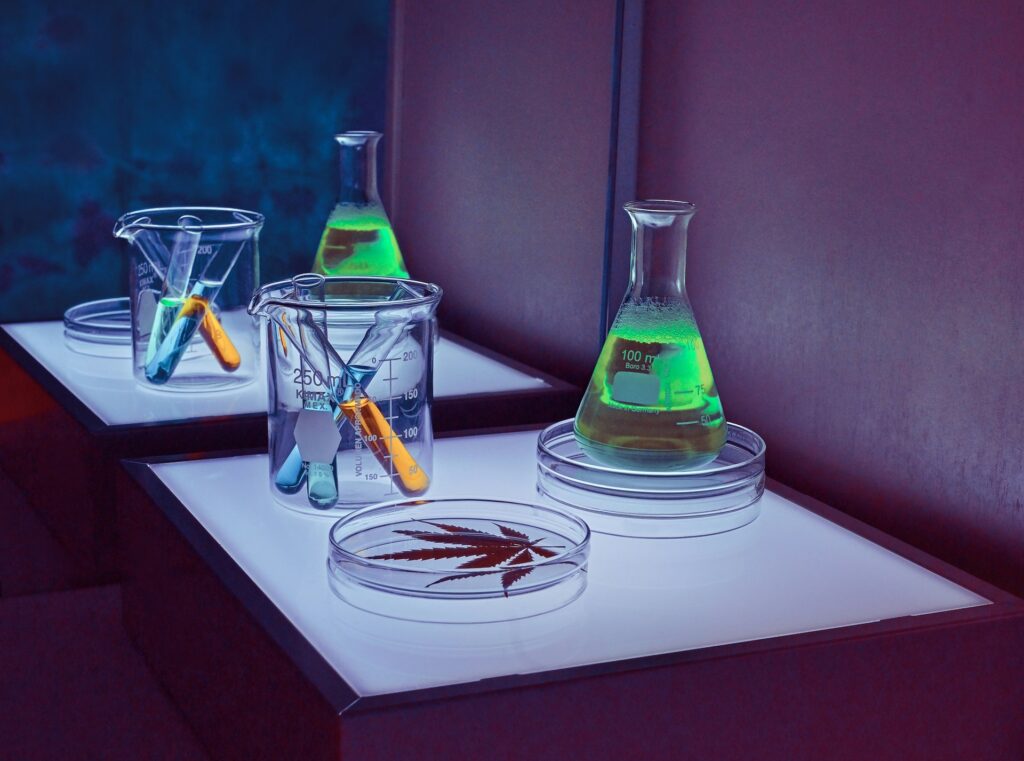
THC and CBD may be the stars of the cannabis show and the two numbers printed biggest on a label, but there is a much larger supporting cast behind them. The cannabis sativa plant produces over 100 other cannabinoids that are only now gaining traction in the community. Here’s what a few of the most talked-about minor cannabinoids actually are, and what’s currently known about them.
What Makes a Cannabinoid Minor?
Cannabis produces over 100 known cannabinoids, but only a handful (mostly THC and CBD) show up in high enough concentrations to dominate most flower. In that sense, minor just refers to relative abundance in the plant, not importance or effect.
Many minor cannabinoids start from the same precursor compound as THC and CBD, called CBGA, before the plant’s enzymes steer them down different chemical pathways.
Because they occur in smaller quantities, minor cannabinoids have historically been harder and more expensive to isolate and study, which is part of why research on them lags behind THC and CBD.
That’s changing as extraction and testing technology improves, but the science here is still generally younger and thinner than what exists for the two major cannabinoids.
The Minor Cannabinoids You Should Know About
Of the hundred-plus minor cannabinoids the cannabis plant produces, only a handful have gotten enough research attention (or commercial interest) to end up on a label or in a study with any regularity. The five most commonly discussed ones are:
- CBG (Cannabigerol)
- CBN (Cannabinol)
- CBC (Cannabichromene)
- THCV (Tetrahydrocannabivarin)
- CBDV (Cannabidivarin)
CBG (Cannabigerol)
CBG is often called the “mother cannabinoid” because CBGA is the precursor from which THC, CBD, and CBC are all synthesized. It’s non-intoxicating and typically found in only small amounts in mature plants since most of it converts into other cannabinoids as the plant grows, though some cultivars are now bred specifically to retain higher CBG levels.
CBN (Cannabinol)
Unlike most cannabinoids, CBN isn’t produced directly by the plant. It forms when THC degrades over time through exposure to heat, light, and oxygen. It’s mildly psychoactive, but considerably less so than THC. CBN has become associated in popular use with nighttime and sleep-focused products, though the underlying research on that specific effect is still limited.
CBC (Cannabichromene)
Cannabichromene (CBC) is another CBGA-derived cannabinoid, non-intoxicating, and one of the original big four cannabinoids identified back in the 1960s alongside THC and CBD. CBC interacts with different cannabinoid receptor pathways than THC, including some involved in inflammation and sensory processing, and is studied in combination with other cannabinoids.
THCV (Tetrahydrocannabivarin)
THCV is structurally similar to THC, but it behaves differently. In low doses, some research suggests it may not produce the same intoxicating effect, but at higher doses it can be psychoactive. It’s found in higher concentrations in certain landrace sativas, including Durban Poison, and has drawn research interest related to appetite and metabolism, though findings remain preliminary.
CBDV (Cannabidivarin)
A structural analog of CBD, CBDV is non-intoxicating and most abundant in certain landrace strains and some hemp varieties. Most current research interest centers on its potential role in neurological contexts, though this remains an early and ongoing area of study.
Why Minor Cannabinoids Matter
Even in small quantities, minor cannabinoids are thought to contribute to what’s often called the entourage effect, which is the idea that cannabinoids and terpenes may interact with and influence each other, thus boosting the experience.
That’s part of why full-spectrum and broad-spectrum products, which preserve a wider range of the plant’s natural compounds, tend to be marketed around synergy and “whole-plant” formulas.
However, research on minor cannabinoids is still developing, and a lot of current marketing claims run ahead of what’s actually been demonstrated in rigorous human studies. Promising early findings are not the same as established effects.
Minor Cannabinoids in Cannabis Products
If a specific minor cannabinoid is what you’re after, here’s what to remember and look for in a dispensary:
- Full-spectrum products retain the broadest range of cannabinoids and terpenes naturally present in the plant, including whatever minor cannabinoids the original flower contained.
- Broad-spectrum products aim for a similar range of compounds, typically without THC.
- Isolate-based products focus on a single, specifically extracted minor cannabinoid, such as CBG or CBN.
Lab reports are the most reliable way to see what’s present in a given product since minor cannabinoid content isn’t always obvious from the strain name alone.
The Bottom Line on Minor Cannabinoids
Minor cannabinoids are an expanding area of cannabis science, but the research base is still considerably thinner than it is for THC and CBD. If you’re curious about trying a product built around a particular minor cannabinoid, the best thing you can do is check the lab results on a specific product or ask one of our budtenders if you’re visiting your nearest Artist Tree location.