
Cannabis science moves fast, and the cannabinoid landscape has expanded well beyond THC and CBD. One of the newer additions to that conversation is HHC, a compound that’s been showing up on dispensary shelves and in online stores with increasing frequency, usually marketed as a legal, milder cousin of THC.
If you’ve seen it on a label and weren’t sure what to make of it, here’s what you need to know and why we don’t carry it.
What is HHC?
HHC stands for hexahydrocannabinol. It’s a cannabinoid that technically does exist in the cannabis plant, but in such minuscule quantities (a small fraction of a percent of the plant’s dry weight) that extracting it directly from cannabis at any real scale just isn’t practical. That means that almost none of the HHC sold commercially comes from a plant at all. It’s made in a lab.
How HHC Is Made
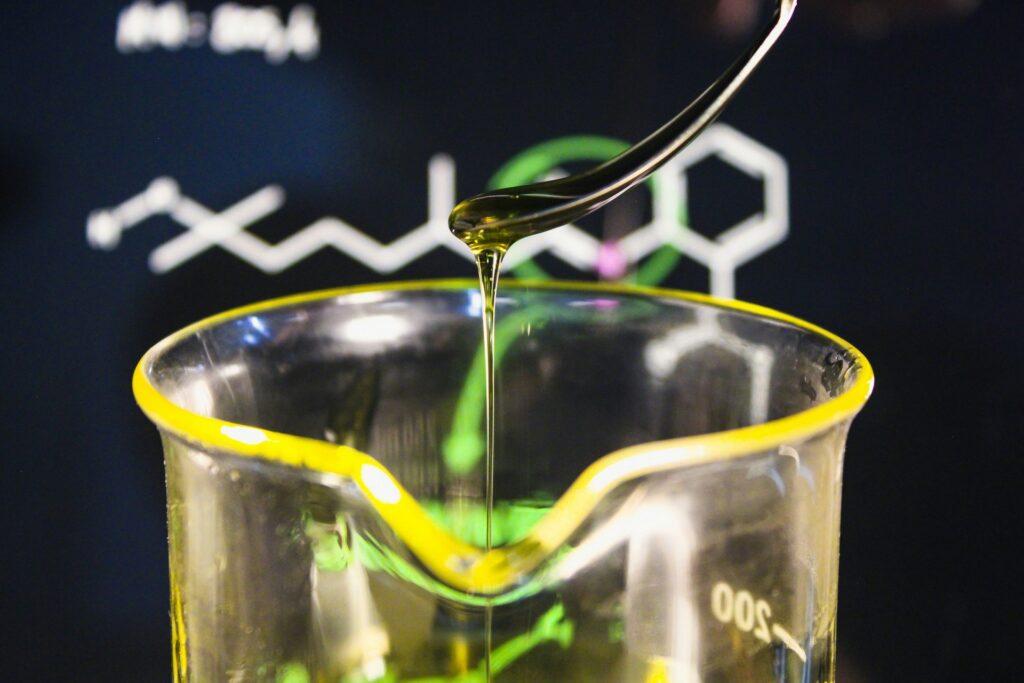
Manufacturers start with CBD, which hemp produces in abundance, and convert it into THC, then push it through a chemical process called hydrogenation, essentially adding hydrogen atoms to the molecule until it becomes HHC. That’s why it’s called semi-synthetic—it starts with something natural (CBD), but is ultimately made in a lab via this chemical process.
The technique isn’t the problem here. Hydrogenation has been in use for decades, particularly in the food industry (it’s how liquid vegetable oil is turned into solid margarine, for example).
What’s new here is turning it into a mass-market consumer product with little oversight, and that’s the issue. Hydrogenation, like the isomerization process used to make delta-8, isn’t a perfectly clean reaction.
Depending on how carefully (or carelessly) a manufacturer runs it, the process can leave behind residual solvents, metal catalysts, and byproduct compounds that have never been studied for human safety.
There’s no regulated manufacturing standard behind any of this. There’s a chemist, a reactor, and whatever quality control that specific manufacturer decided to bother with.
HHC (Hexahydrocannabinol) vs. Delta-9 THC
The reason why HHC is often marketed as THC’s cousin is that the two compounds are molecularly almost identical, differing by just two hydrogen atoms and the absence of a double bond. The real difference (and risk) lies in how each is made, tested, and regulated.
| HHC | THC | |
| Psychoactive? | Yes, generally described as milder | Yes, full range from mild to intense, depending on the product |
| Natural abundance in plant | Trace amounts only | High in most cannabis cultivars |
| How it’s typically produced | Converted from CBD via hydrogenation | Extracted or concentrated directly from the plant |
| Lab testing required | No, unregulated market | Yes, mandatory at licensed dispensaries |
| Legal status | Schedule I, with the commercial market closing | Regulated under state cannabis programs |
| Shows up on a drug test | Often, though, detection research is still developing | Yes |
| Where it’s sold | Gas stations, smoke shops, online, with no license required | Licensed, regulated dispensaries only |
Why We Don’t Carry HHC Products
HHC isn’t legal here in California, and even if its status were murkier like in other states, we wouldn’t sell it anyway.
California closed this loophole decisively with Assembly Bill 8, effective January 1, 2026. AB 8 explicitly classifies HHC as a synthetic cannabinoid and bans it, along with delta-8, delta-10, and THC-O. It’s not a gray area here, the way it still is in some other states.
That state-level ban is also now backed up federally. The DEA has long treated HHC as Schedule I under the broader “tetrahydrocannabinols” category. In May 2026, it gave HHC its own specific listing and drug code to make that status explicit. A separate federal law signed in November 2025 closes the broader hemp loophole that products like HHC and delta-8 relied on nationally, moving federal hemp regulation to a “total THC” standard that most synthetic, converted cannabinoids won’t be able to meet once it takes full effect in November 2026.
Beyond the legal question, licensed California dispensaries like ours only sell products that go through mandatory, DCC-regulated lab testing for potency, pesticides, heavy metals, and residual solvents. HHC, as a synthetic compound manufactured almost entirely outside that regulated supply chain, doesn’t fit into that framework, and we’re not willing to sell you something we can’t vouch for.
What to Try Instead of HHC
If what actually appeals to you about HHC is the idea of a milder, gentler experience, you don’t need an unregulated synthetic compound to get there. There are plenty of real, lab-tested options built for exactly that:
- Low-dose THC edibles or gummies: Products in the 2.5–5mg range per serving are designed to ease you in gently, without the intensity of a full-strength serving.
- THC: CBD ratio products: A higher ratio of CBD alongside THC tends to soften the psychoactive edge while still delivering real, tested effects. These are widely available and clearly labeled.
- Low-potency flower or pre-rolls: Not every flower product is about maximizing THC percentage. Plenty of options are formulated specifically for a lighter, more manageable experience.
- Microdose tinctures: Precise, easy-to-control dosing if you want to find your ideal comfort zone.
Each one of these comes with a lab report you can check and is made from a plant, not synthesized in a reactor with unknown byproducts along for the ride.
If You Decide to Give HHC a Try, Here’s What to Check
If you’re going to give HHC a try anyway (it’s still sitting on plenty of shelves while enforcement catches up), you should know what to look for to minimize risk:
- A real third-party certificate of analysis (COA): Confirms potency and screening for residual solvents, heavy metals, and pesticides instead of a generic PDF copied across every product on the site.
- A batch or lot number that actually matches the COA on file: So you know the test results correspond to the product in your hand.
- Clear disclosure of the production process: Since hydrogenation quality varies enormously between manufacturers, this can give you an insight into how safely a product was made.
- No vague sourcing claims: If a brand can’t say where its starting material came from, that’s a red flag.
- Skip anything sold with no age verification: A legitimate, safety-conscious seller checks ID, regardless of what the law technically requires in a given state.
None of this makes HHC products safe. It just separates the reckless end of an already unregulated market from the slightly less reckless end.
We’re Here to Help
HHC’s whole appeal was built on a legal gray area that’s now closing, and on a “natural cannabinoid” framing that doesn’t hold up once you learn how it’s produced. If you’re after a gentler cannabis experience, that’s a completely reasonable thing to want. You just don’t need to gamble on an unregulated compound to get there. Stop by your nearest dispensary and talk to one of our budtenders. We’ll help you find a tested, regulated product that actually matches the experience you’re looking for.