
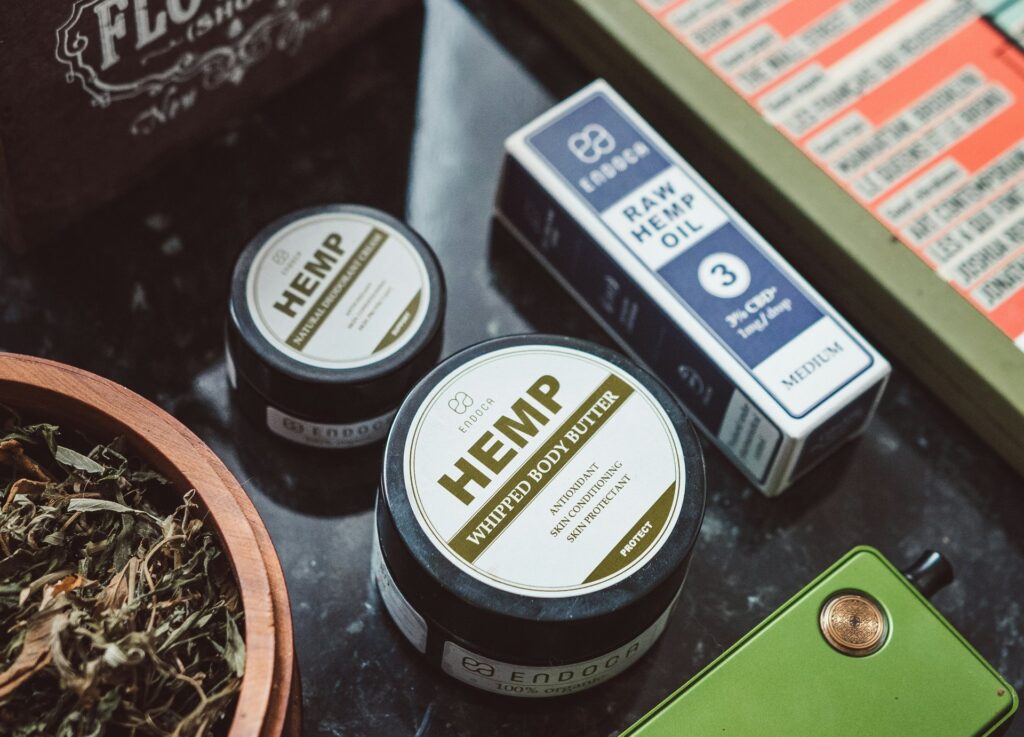
That’s what everyone wants to know, and we’ll just go ahead and give you the answer right away: the short answer is no. At least not most topicals. The longer answer is that there are exceptions, as not all topicals are created equal, and that longer answer matters if you’re looking to avoid THC altogether for whatever reason.
Types of THC Topicals
Cannabis topicals come in several different formats.
- Balms and salves: Thick, wax-based products that sit on the skin and absorb slowly. They’re good for targeted application on a specific spot like a sore joint or a tight muscle, and tend to last longer on the skin than lighter formulas.
- Creams and lotions: These have a lighter texture and absorb more quickly, which makes them easier to apply over larger areas. They’re a good everyday option for general soreness or skin hydration alongside the cannabinoid benefits.
- Oils and serums: The most lightweight formats that absorb fastest. They’re often used for facial skin care or for covering a broad area without leaving a heavy residue.
- Roll-ons and sticks: Designed for convenience and precision, these are easy to apply directly to a specific spot without getting product on your hands. Popular for on-the-go use after a workout or during travel.
How THC Topicals Work
When you apply a topical to your skin, the cannabinoids don’t travel into your bloodstream the way they do when you smoke, eat an edible, or take a tincture. They interact with cannabinoid receptors (CB1 and CB2) located in the skin, muscles, and surrounding tissue locally, right where you applied the product.
Our skin is a remarkably effective barrier, though. It’s designed to keep things out, and THC is no exception. Even when you apply a THC-infused balm generously, the cannabinoids don’t penetrate deep enough to reach the bloodstream in any meaningful quantity.
Simply put, no bloodstream means no brain, and no brain means no high.
That localized interaction is the point. People use THC topicals for targeted relief for sore muscles, joint discomfort, inflammation, or skin irritation, and the effect stays where you put it.
Transdermal Patches Are the Exception
As we said, not all cannabis topicals are created equal, and there’s one category that works very differently from the rest: transdermal patches.
Unlike creams and balms, transdermal patches are specifically engineered to push cannabinoids through the skin barrier and into the bloodstream. They use chemical penetration enhancers to do what regular topicals can’t, which means transdermal THC patches can produce systemic effects, including intoxication.
Key differences to know:
- Regular topicals (creams, balms, salves, lotions): Stay local, don’t enter the bloodstream, and won’t get you high.
- Transdermal patches: Designed to penetrate the skin barrier and enter the bloodstream, so they can produce psychoactive effects depending on the THC dose.
If you’re specifically looking to avoid any psychoactive effect, regular topicals are the safer choice. If you’re looking at patches, check the label and ask your budtender what to expect.
Will THC Lotion Show Up on a Drug Test?
For most standard topicals, the answer is very likely no. Since THC doesn’t enter the bloodstream in any significant amount, it doesn’t produce the THC metabolites that drug tests screen for.
For transdermal patches, it depends. Because they’re designed to deliver THC into the bloodstream, regular use could potentially trigger a positive result on a drug test.
If you’re subject to drug testing, stick to non-transdermal topicals and look for third-party lab results confirming what’s in the product.
What Are Cannabis Topicals Actually Used For?
Without the psychoactive component, one might wonder what the point of THC in a topical is at all, and it’s a fair question. The answer comes back to those cannabinoid receptors in the skin and surrounding tissue. Activating them locally can influence inflammation, pain signaling, and skin health without producing a high.
People commonly use THC topicals for:
- Muscle soreness and tension after exercise or physical activity
- Joint discomfort and stiffness
- Localized inflammation
- Skin conditions like dryness, irritation, and redness
- General recovery support
As with most cannabis applications, the evidence base here is a mix of early research and strong anecdotal reporting. The FDA hasn’t approved THC topicals for any of these uses, and individual results vary. But the category has grown considerably, and a lot of people find them useful for day-to-day physical discomfort.
CBD vs. THC Topicals: Is There a Difference?
Both work locally through the same basic mechanism by having cannabinoids interact with receptors in the skin and tissue without entering the bloodstream. Here’s how THC and CBD topicals stack up.
| THC Topicals | CBD Topicals | |
|---|---|---|
| How they work | Interact with CB1 and CB2 receptors locally in the skin and tissue | Primarily interact with CB2 receptors locally in the skin and tissue |
| Psychoactive? | No (unless transdermal) | No |
| Where to buy | Licensed cannabis dispensaries | Dispensaries, wellness stores, online |
| Lab testing | Required by state regulation | Varies, but third-party COA is recommended |
| Often combined? | Yes, many topicals contain both THC and CBD | Yes, commonly paired with THC |
Many topicals combine both cannabinoids, and some people report that combination feels more effective than either alone, which the entourage effect theory offers a plausible explanation for, though the clinical evidence is still developing.
Find the Right Topical at The Artist Tree
If you’ve never tried a cannabis topical before, they’re one of the lower-stakes ways to explore what THC and CBD can do. There’s no onset window to manage, no dosing curve to figure out, and no concern about getting high when using a standard cream or balm. You apply it, see how it feels, and go from there.
At The Artist Tree, we carry a range of topicals across formats and cannabinoid profiles. Stop by any of our California locations, and our guides can help you find something worth trying.